When managing complex logistics for a large Cat® dealer, scaling warehouse management software isn’t an IT upgrade. It’s a complete operational evolution. At Carter Machinery, deploying a connected system to manage 40,000 lines per week across 28 warehouses and 40 active shuttle routes required an approach grounded in deep domain knowledge, strategic planning, and unwavering leadership.
Led by Brent Whitlow, Carter Machinery successfully migrated from its legacy warehouse management system (WMS) to the warehouse management and package tracking solution from FDC Solutions, which includes WMSv2 for warehouse management and K*Track for package tracking, route management, and order communications.
Keep reading to learn how Brent structured, managed, and executed this multi-facility deployment.
The Integrated Tech Stack: Two Pillars of Success
To eliminate manual data entry, reduce exception rates, and gain complete end-to-end visibility, Brent deployed an integrated software solution.
WMSv2 handles inventory control, receiving, putaway, picking, and cycle counting in Carter’s warehouses.
K*Track coordinates corporate shuttle routes, node management, customer pick-ups, automated delivery notifications, and automated order-lifecycle alerts that meet Caterpillar’s Global Dealer Standards for ecommerce.
A Playbook for Rapid, Scalable Deployment
Scaling from 6 warehouses using the previous WMS to 28 warehouses using the new solution in under two years was no small feat. Brent's strategy relied on strong project management processes, adherence to a strict internal deployment "playbook," and direct involvement from experienced operations personnel.
Building the Dedicated Internal Team
To supplement guidance provided by the implementation consultants from FDC Solutions, Brent assembled a core deployment team of five experienced parts supervisors and administrators. A key success factor was that the deployment team members understood daily warehouse operations, ensuring practical execution, seamless peer-to-peer communication, and immediate trust on the shop floor.
Executing the Phased Rollout Methodology
Carter’s 28-location deployment was executed using a disciplined three-phase approach.
Phase 1: Pre-Work and Facility Mapping. Mapped, measured, and labeled every bin location, rack, and aisle using existing floor data and Visio drawings.
Phase 2: Hardware and Infrastructure Alignment. Performed Wi-Fi site assessments and installed power drops at packing stations, and partnered with Decision Point Technologies for hardware selection and maintenance.
Phase 3: Facility-Specific Go-Lives. Carter managed the process leading up to go-live at each facility by training supervisors several weeks before go-live and then sending a deployment team on-site during the week of go-live for training assessments and additional training as needed.
Key Lessons and Operational Insights
Looking back on a successful deployment, Brent identified four critical factors that drove success throughout the project.
Floor Training Over Classroom Instruction. Hands-on training directly on the warehouse floor proved far more effective than classroom presentations.
Hardware Standardization. Carter standardized on Zebra MC9300 and MC9400 scanners. For tagging, Carter used Zebra ZQ620 mobile printers with LED screens and noted that the non-LED models suffered from Wi-Fi dropouts. Brent’s team and store managers mounted hardware on mobile carts for ease of movement.
Cost-Effective Will-Call Signatures. Instead of expensive alternatives, Carter deployed Samsung Galaxy Tab A tablets in heavy-duty cases, allowing store personnel to push orders directly to tablets for electronic customer signatures.
Executive Backing. Strong support from the executive leadership team at Carter provided the financial backing, resources, and institutional push needed to maintain momentum.
Real-World Operational Results
By moving to an integrated system that Brent refers to as The Connected Warehouse, Carter Machinery has unlocked significant operational advantages.
Accuracy and Efficiency. Barcode scanning eliminated manual data entry, slashed error rates, and dramatically reduced inventory exceptions.
Full Accountability. Every transaction, from receiving to delivery, is tied to individual user logins, providing complete traceability.
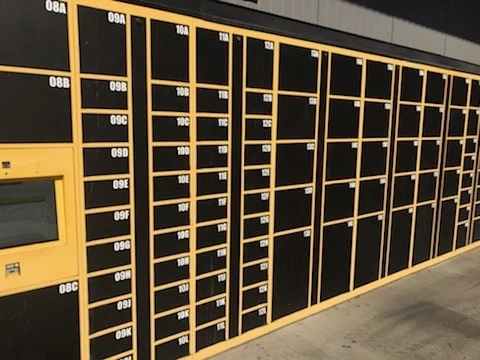 24/7 Access via Smart Lockers. Using integrated self-service lockers controlled by K*Track and accompanied by video security at the lockers, Carter’s customers can now pick up their parts orders anytime using express loyalty cards and/or barcodes sent to their phones.
Enhanced Logistics Tracking. Internal drivers document deliveries using Zebra TC73/TC78 mobile devices, while delivery documents from third-party couriers are scanned into K*Track for proof of delivery.
Long-Term Sustainability and Next-Level Innovation
To ensure long-term stability across all 28 warehouses, Carter Machinery created a permanent WMS Administrator role. Supported by a team of 1-2 people, the WMS Administrator oversees SOPs, system updates, ongoing user training, and daily support.
Looking ahead, Carter Machinery is continuing to innovate.
AutoStore™ and Automation Integration. Using WMSv2 as a base, Carter has deployed an AutoStore™ automated storage and retrieval system at its warehouse in Baltimore.
Automation Integration. Using WMSv2 as a base, Carter can now deploy a variety of automated storage and retrieval systems at any of its warehouses.
Data-Driven Performance Metrics. Combining transaction logs WMSv2 and K*Track with payroll data is allowing Carter to measure individual and store-level productivity.
Advanced Warehouse Intelligence. Updating each store’s warehouse drawings is enabling warehouse heat mapping, route optimization, and AI-driven workload balancing.
By pairing robust technology from FDC Solutions with practical, operational-focused project leadership, Brent and his team have created a scalable blueprint for the modern, connected Cat® dealer warehouse.
EXPERIENCED LEADERSHIP
Brent Whitlow
ERP Application Senior Specialist
 Brent Whitlow brings over 18 years of dealership experience spanning Parts, Sales, Marketing, and Continuous Improvement. He specializes in warehouse operations and has successfully led the deployment of multiple Warehouse Management System (WMS) solutions at the dealer level.
Brent holds an MBA and is a Six Sigma Black Belt, with a strong focus on optimizing processes and leveraging technology to improve operational efficiency and drive business performance.
Ready to learn more?
Complete the form below and allow a member of our team to show you how the warehouse management and package tracking solution from FDC Solutions can put your company on the path to a complete operational evolution.